
The best haircuts for kids match two things: your child’s hair texture and your morning routine. For most families, that means a crew cut, a taper fade, a chin-length bob, or a layered mid-length cut. These four suit almost every hair type, need under two minutes of styling, and hold their shape for six to eight weeks.
Below are 15 kids’ haircuts that work in real life. Each one tells you who it suits, the exact words to say at the salon, and how often it needs a trim.
First, a Myth Worth Clearing Up
Many parents believe cutting a child’s hair makes it grow back thicker. It does not.
New hair is made inside the follicle, a small pocket that sits under the scalp. Scissors work well above that point and never touch it. Cutting removes the end of the strand, and the end has no say in how the root behaves.
So why does hair feel thicker after a cut? A strand that has grown for months tapers to a fine point. Cut that point off and the remaining end is wider. It feels coarser between your fingers and looks fuller. The hair itself has not changed.
This matters when you book. Parents often keep hair long hoping it will thicken, or shave it short hoping for stronger regrowth. Neither works. Choose the cut that suits the hair your child has today.
The TRIM Test: How to Pick the Right Cut
Run your child’s hair through four questions before you book. We call it the TRIM Test. It takes thirty seconds.
T — Texture. Straight, wavy, curly, or coily? Curls shrink as they dry, so a curly cut always looks shorter than it did when wet. Straight hair shows every line, so blunt cuts need precision.
R — Routine. How many minutes do you really have on a school morning? Be honest. A style needing five minutes of brushing gets abandoned by week two.
I — Involvement. Does your child want a say? A child who picked their own haircut sits still for it and looks after it. A child who did not will fight the brush daily.
M — Maintenance. Realistically, how often will you book the next appointment? Very short cuts lose shape in four weeks. Long layers hold for ten.
Match all four and the haircut works. Miss one, usually Routine, and you will be back within a month asking for something easier.
| Cut type | Best for | Morning time | Rebook |
|---|---|---|---|
| Very short (crew, buzz, fade) | Active kids, all textures | Under 1 min | 4–5 weeks |
| Short (pixie, crop, bob) | Fine to medium hair | 1–2 min | 6–8 weeks |
| Mid-length layered | Thick or wavy hair | 2–3 min | 8–10 weeks |
| Long with shaping | Kids who want length | 3–5 min | 10–12 weeks |
Best Haircuts For Kids: Short and Low-Maintenance
1. Classic Crew Cut
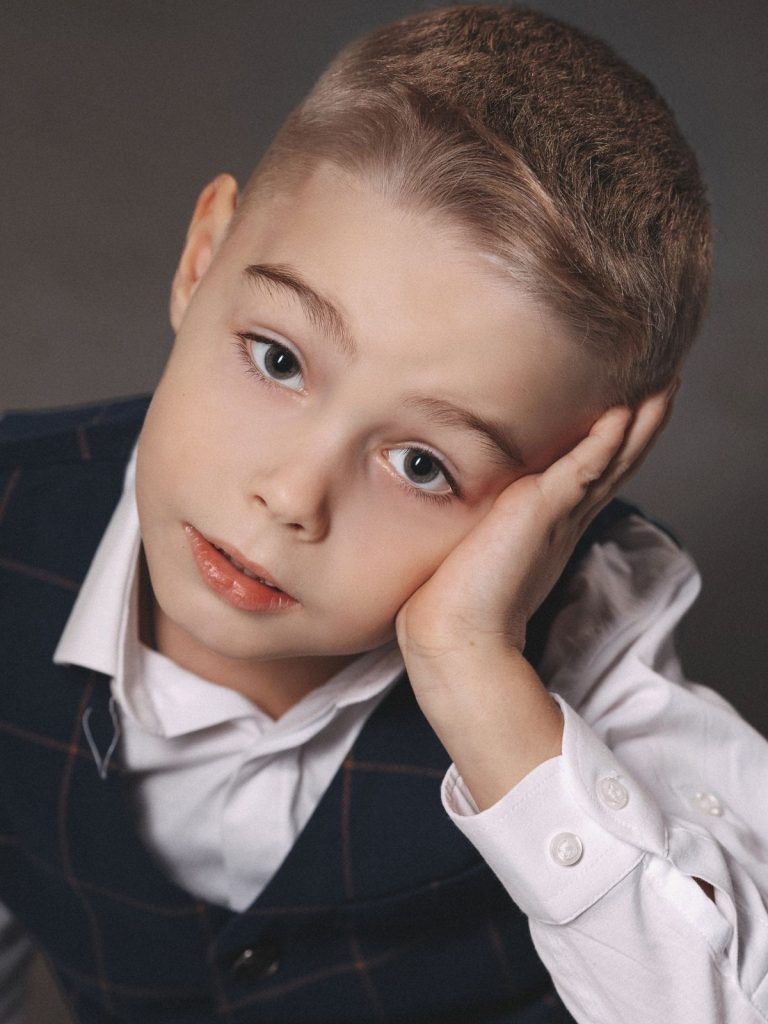
Short at the back and sides, slightly longer on top, blended smooth. It is tidy, needs no product, and survives sport and swimming. It stays wearable even at week seven, which makes it one of the most forgiving cuts here.
Best for: Medium to thick hair that falls straight or waves slightly. Suits round, square and oval faces. Ages 3–12.
Ask your stylist for: A #2 guard on the back and sides, scissor-over-comb on top, blended at the temples.
Rebook: 4–5 weeks.
2. Taper Fade
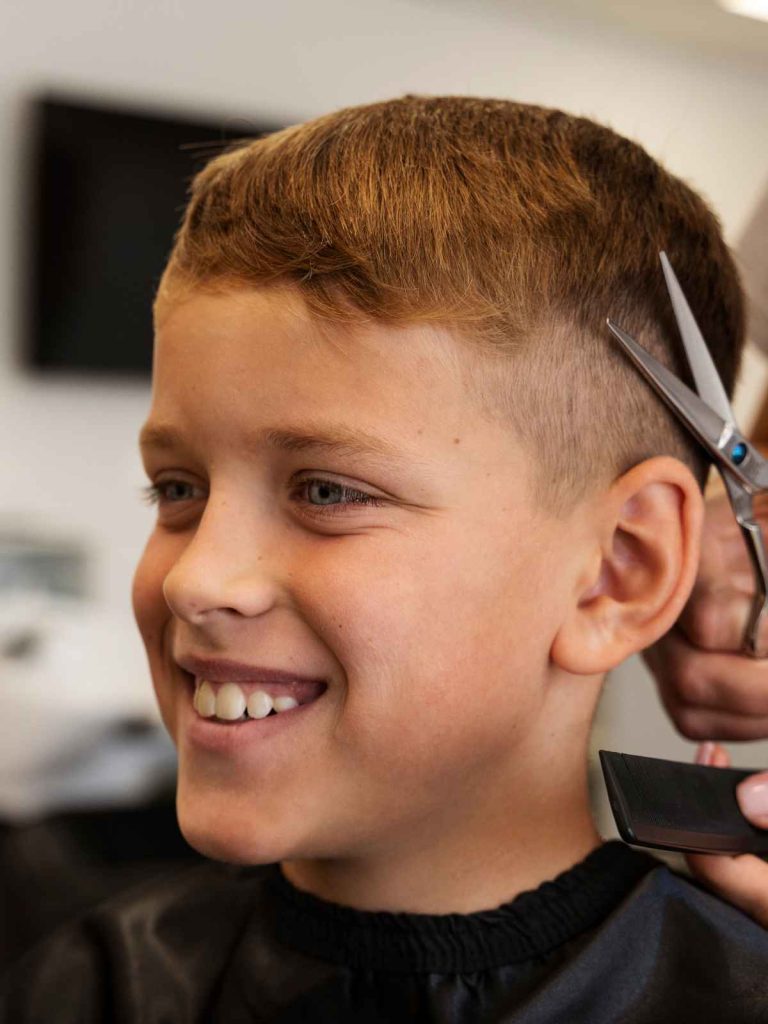
The sides start short and get shorter towards the neckline. It looks sharp on thick or coarse hair and is the most requested cut among pre-teens. Be aware it grows out fast. The fade line blurs by week three and the shape is gone by week five.
Best for: Thick, coarse, and curly hair. Most face shapes. Ages 4–14.
Ask your stylist for: A low taper starting at a #1 and graduating to a #3, with a natural neckline.
Rebook: 4 weeks. This is the highest-commitment cut on the list.
3. Undercut
Short sides and back with the top left noticeably longer, so there is a clear contrast between the two. It gives older kids a bold look while keeping the hard-working part short. The top can be worn forward, swept back, or spiked.
Best for: Kids with enough density to carry a long top. Oval and square faces. Ages 7–14.
Ask your stylist for: A disconnected #2 on the sides with at least two inches left on top.
Rebook: 5–6 weeks.
4. Textured Crop
Short sides with a choppy top that falls forward. This is the cut for hair that will not sit flat, because the texture hides cowlicks and double crowns instead of fighting them. It also works spiked up with a little clay for kids who want that.
Best for: Hair that refuses to lie flat, including cowlicks and double crowns. Oval and long faces. Ages 5–14.
Ask your stylist for: A #2 on the back and sides, point-cut through the top, with a soft blended fringe.
Rebook: 6 weeks.
5. Classic Side Part
Hair combed neatly to one side with a defined parting. It is the smartest-looking cut here, which makes it a favourite for weddings, school photos, and anything formal. It also works day-to-day if your child likes a tidy look.
Best for: Finer, straighter hair that holds a parting. Works on any face shape. Ages 4–14.
Ask your stylist for: A scissor cut with a soft taper at the sides and enough length on top to hold a parting.
Rebook: 6–8 weeks.
6. Curly Top with Short Sides
Sides kept short, curls left full on top. It removes bulk without cutting into the curl pattern, which is exactly what curly hair needs. The top must be cut dry, curl by curl, so the stylist can see how each one actually sits.
Best for: Wavy, curly, and coily hair (2b–4a). Round and square faces. Ages 3–14.
Ask your stylist for: A #2 on the sides, top cut dry. No thinning shears.
Rebook: 6–8 weeks.
7. Buzz Cut
One length all over with clippers. It is the lowest-maintenance haircut that exists, and the right answer for summer, for children who cannot sit through a long appointment, and for hair growing back after lice treatment. There is no awkward grow-out phase at all.
Best for: All hair types and face shapes. Ages 1–14.
Ask your stylist for: A single #3 or #4 guard with a tapered neckline. Nothing below a #2 on a first buzz.
Rebook: 4 weeks, or let it grow into a crew cut.
Best Haircut For Girls
8. Chin-Length Bob
A clean, blunt cut at the jawline. It is the easiest haircut for girls to manage because it needs no clips, no ties, and no styling. The blunt edge also makes fine hair look denser, since a straight line catches more light than a thinned one.
Best for: Fine to medium hair. Oval, heart, and long faces. Ages 4–14.
Ask your stylist for: One length on a horizontal baseline, no internal layering.
Rebook: 6–8 weeks.
9. Pixie Cut
Short at the back and sides, longer on top, tapered at the neck. It is the fastest morning style on this list. One honest warning worth giving parents at the consultation: around week eight the sides reach the ears and it looks awkward for a fortnight. Knowing that in advance prevents disappointment.
Best for: Fine to medium hair. Oval and heart faces. Ages 5–14.
Ask your stylist for: Graduation through the crown and a softly tapered nape, not a sharp line.
Rebook: 5–6 weeks.
10. Long Layers
Length kept, with layers cut through the mid-lengths to remove weight. This is the fix when a child wants long hair but it has gone heavy and flat. It also gives the most value per appointment, because it grows out slowly and looks good the whole way.
Best for: Thick, heavy, straight or wavy hair. All face shapes. Ages 6–14.
Ask your stylist for: Layers starting below the chin, not at the crown, with the baseline kept blunt.
Rebook: 10–12 weeks.
11. Shoulder-Length with Face-Framing Pieces
Hair at the shoulders with shorter pieces around the face. It ties into a ponytail or plait without loose bits escaping, which makes it the most practical kids hairstyle for school. Honestly, this is the safest choice on the list for almost any child.
Best for: All textures. Round and square faces especially. Ages 5–14.
Ask your stylist for: A blunt baseline at the shoulder with face-framing layers starting at the cheekbone.
Rebook: 8–10 weeks.
12. Curly Shag
Layers cut throughout so curls stack and spring instead of sitting in a triangle. This is the cut for hair that grows outwards rather than down. It must be cut dry. Cutting curls wet is the single most common reason a curly cut comes out shorter and boxier than expected.
Best for: Curly and coily hair (3a–4c). All face shapes. Ages 5–14.
Ask your stylist for: Heavy layering cut dry, curl by curl. No thinning shears, no wet cutting.
Rebook: 10–12 weeks. Curls hide regrowth better than any other texture.
Kids Hairstyle Options That Suit Everyone
13. Side-Swept Fringe
A fringe cut on an angle so it sweeps across the forehead. It keeps hair out of the eyes without a clip and is easier to live with than a straight fringe. The fringe grows into the eyes faster than anything else here, so it needs its own trim schedule.
Best for: Straight and wavy hair. Round and square faces. Ages 4–14.
Ask your stylist for: A diagonal fringe, point-cut, longest at the outer corner, falling just past the eyebrow.
Rebook: Fringe trim every 4 weeks, even if the rest is left alone.
14. Top Knot Cut
Hair kept long enough to gather into a bun on top. It keeps hair completely off the face, which makes it the practical pick for sport, dance, and swimming. The same length also ties easily into pigtails or plaits on days when a bun is too much effort.
Best for: Medium to thick hair. All face shapes. Ages 5–14.
Ask your stylist for: An even one length with no layers, so no short pieces escape the knot.
Rebook: 10 weeks. Use a fabric or spiral tie rather than an elastic band to avoid breakage in the same spot.
15. Grown-Out Crop
Slightly longer all over with the weight removed from underneath. This is the cut for a child growing their hair out who does not want to look untidy for six months. The outline stays untouched and only the bulk comes off, so the length keeps building.
Best for: Any texture. All face shapes. Ages 5–14.
Ask your stylist for: Internal debulking with the outline left alone, using invisible layering.
Rebook: 8 weeks, for debulking only, not for length.
Making the Cut Last
Most kids’ haircuts fail between appointments, not in the chair. Three habits fix that.
Wash less often than you think. Children’s scalps make less oil than adults’, and daily washing strips what little there is. Two or three washes a week suits most kids, more if they swim regularly.
Detangle from the ends upwards, never from the roots down. Starting at the top drags every knot into a tighter one, which is why brushing turns into a fight. A wide-tooth comb on damp hair, worked up from the tips, takes half the time and causes none of the tears.
Book the next appointment before you leave. The rebook windows above are not suggestions. A four-week fade seen at week eight is a different haircut entirely, and rarely one your child likes.
FAQs Related to Best Haircuts For Kids
How often should kids get a haircut?
Every six to eight weeks for most styles. Crew cuts, buzz cuts, and fades need trimming every four to five weeks because they lose shape quickly. Long layers stretch to ten or twelve weeks. Fringes always need more frequent trims, usually every four weeks.
Does cutting a child’s hair make it grow back thicker?
No. Hair grows from the follicle under the skin, and cutting the end has no effect on the root. A fresh cut feels thicker only because the blunt end is wider than the naturally tapered tip.
What age should a child get their first haircut?
There is no medical reason to rush or wait. Most families go between nine months and two years, usually when hair starts falling into the eyes. Your child’s comfort matters more than their age.
Which haircut is easiest to manage for kids?
A buzz cut or crew cut for very short hair, and a chin-length blunt bob for anything longer. All three need no product, no clips, and under a minute in the morning.
What is the best haircut for girls with curly hair?
A curly shag or a layered cut shaped while the hair is dry. Wet cutting is the main reason curly cuts come out shorter than expected, because curls shrink as they dry.
How do I keep my child calm during a haircut?
Book a morning slot when they are rested, explain what will happen beforehand, and let them pick the style from photos. Children who choose their own haircut sit still far more often.
Can kids have a fringe?
Yes. A side-swept fringe is the easier version to live with. A straight fringe needs trimming every three to four weeks to stay clear of the eyes.
What should I ask for at the salon?
Describe the length and shape rather than naming a trend. “Short on the sides, longer on top, blended” communicates far more than a style name, which means different things in different salons.
Which haircuts suit fine hair on children?
Blunt cuts. A chin-length bob or a one-length mid-length cut makes fine hair look denser, because a straight edge reflects more light than a thinned, layered one.
Are these haircuts suitable for both boys and girls?
Yes. Hair texture matters far more than gender. A curly shag works on any child with curls, and a crew cut works on any child with straight hair, whatever they call it.